
New research examines climate misinformation in Canada’s agri-food sector
A new study by Khondokar H. Kabir and Ataharul Chowdhury, School of Environmental Design and Rural Development, University of Guelph, examines how Canadian agri-food professionals understand the causes and persistence of climate misinformation.
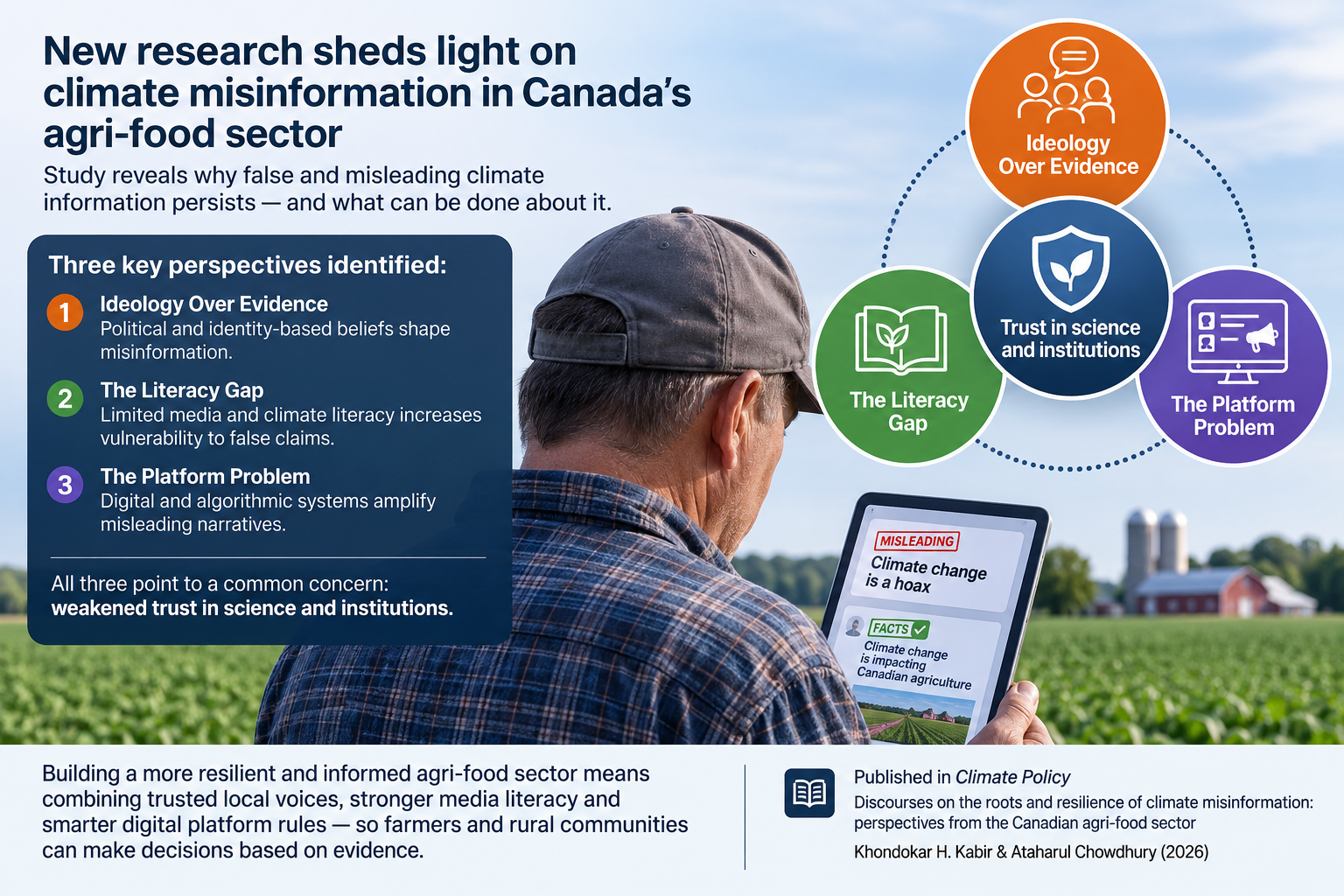
Published in Climate Policy, the study identifies three distinct perspectives: “Ideology Over Evidence,” “The Literacy Gap,” and “The Platform Problem.” Together, they show that climate misinformation cannot be addressed through fact-checking alone. Political and identity-based beliefs, gaps in critical and media literacy, and the ways digital platforms amplify misleading information all contribute to the problem.
The study highlights the importance of trusted local messengers, stronger media and climate literacy, capable extension and advisory services, and greater accountability in digital and AI-based information platforms. Across the three perspectives, a common concern emerged: misinformation can weaken trust in science and institutions, making evidence-based climate adaptation more difficult in agriculture.
The research emphasizes that strengthening the resilience of Canada’s agri-food sector requires not only better climate information, but also stronger capacity to assess, communicate and act on that information.
